The Final Frontier: How Might the Universe Conclude?
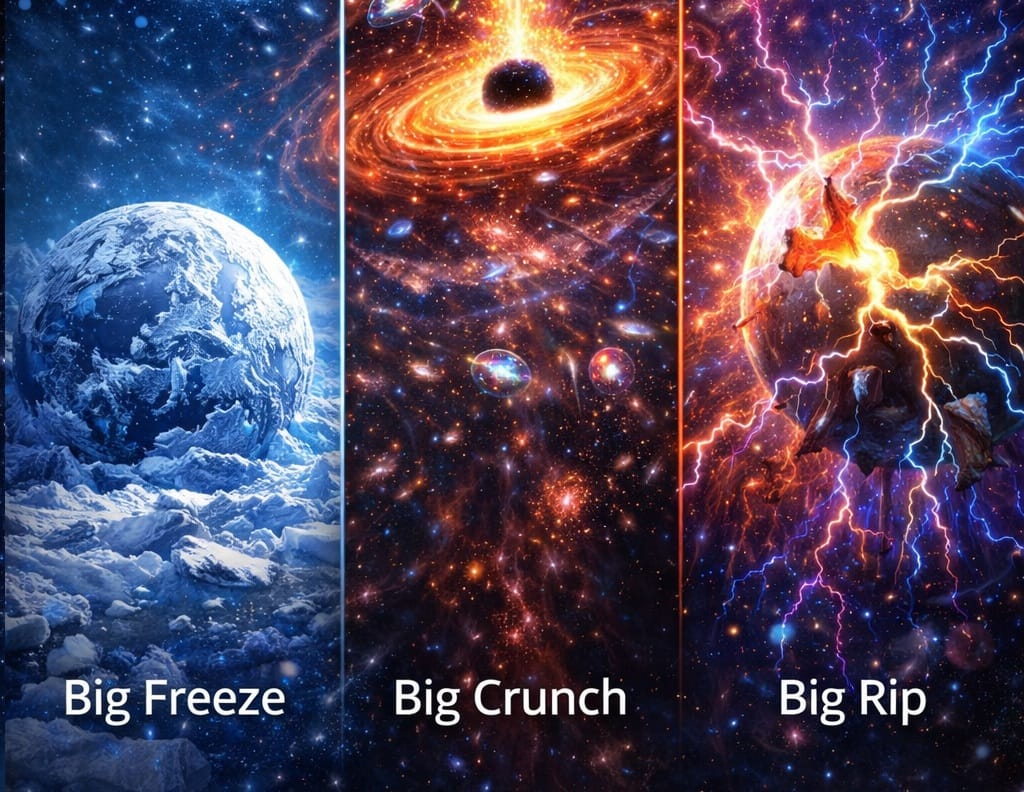
In a few billion years, our Milky Way might experience a spectacular encounter with the Andromeda galaxy, its closest spiral neighbor, giving future observers an awe-inspiring view. But the bigger question remains: how will the universe meet its end?
As an astrophysicist, I’m often asked, "Will the universe actually end?" While definitive answers are elusive, current evidence indicates that the universe will persist as humanity's cosmic abode for an incredibly long time.
The Cosmic Journey
The universe, encompassing all of space, time, matter, and energy, originated approximately 14 billion years ago through an event known as the Big Bang. Since that monumental moment, the universe has undergone continual transformation. Initially, it was a cornucopia of gas containing the fundamental particles—protons, neutrons, and electrons—that combine to form atoms. This dispersed gas eventually coalesced into stars and galaxies.
Forecasting the Future through Observation
Our predictions about the universe’s potential future are grounded in observations of contemporary cosmic phenomena. By studying the behavior of distant galaxies, I can formulate theories that help anticipate how stars and galaxies might evolve over time.
One core principle in physics entails making predictions based on previous observations, a method known as extrapolation. This technique is inherently risky as unforeseen events could alter the anticipated trajectory.
Understanding Galactic Evolution
Consider a scenario where we have pictures of ourselves at ages 5 and 7; one could interpolate to estimate what we looked like at 6. However, projecting far into the future poses challenges, similar to forecasting what one may look like at 29. Similarly, while scientists can reasonably predict the universe's form several billion years ahead, unpredictable developments may occur.
Future of our Sun and Stars
The good news is that our Sun will continue to shine for several billion more years, as it is currently halfway through its estimated 10 billion-year lifespan. The longevity of a star varies according to its size; larger, hotter stars have shorter lifespans while smaller, cooler stars tend to exist for much longer.
Currently, some galaxies are still generating new stars, while others have exhausted their star-forming material. Once a galaxy ceases to create new stars, its blue stars rapidly explode as supernovae within mere millions of years. Over time, yellow stars like our Sun will shed their outer layers, leaving behind a sparse collection of aging red stars. Eventually, all galaxies will cease star production, resulting in a universe gradually dimming and shifting towards a reddish hue.
Galactic Dynamics
Like constructing a sandcastle with buckets of sand, galaxies expand by assimilating smaller celestial bodies. This process of galactic mergers will continue into the distant future.
Within galaxy clusters, numerous galaxies spiral inward towards a common center, leading to chaotic collisions. In these instances, orderly spiral galaxies amalgamate into irregularly shaped clouds of stars, similar to a sandcastle collapsing from a kick. This phenomenon will result in a decrease in spiral galaxies over time, replaced by an abundance of elliptical galaxies.
In a few billion years, our Milky Way and the Andromeda galaxy are expected to merge in such a manner, providing future spectators a breathtaking cosmic sight while causing no harm to the individual stars involved.
The Fate of the Universe
The expansion initiated by the Big Bang will likely persist in some form into eternity. The gravitational pull of stars, galaxies, gas, and dark matter exerts an inward force that may slow this expansion down, with some theories proposing that it will eventually cease altogether.
However, emerging evidence hints at the presence of a mysterious repulsive force—dubbed dark energy—that appears to be accelerating the universe's expansion. Under this scenario, galaxies will accelerate away from each other like raisins within a baking cookie. This could lead to a future where other galaxies become inaccessible from the Milky Way due to immense distances.
A Distant Cosmic Future
Once star formation halts and galaxies converge into colossal elliptical formations, the universe's expansion could render other galaxies invisible except those in our immediate vicinity. Picture the night sky featuring a solitary red elliptical galaxy.
In summary, the future of the universe may see star formation coming to an end, leaving galaxies populated with aging, red dwarfs that gradually drift into darkness over trillions of years. Eventually, galaxy clusters may fuse into a singular massive elliptical galaxy. Coupled with the accelerated expansion of the universe, this could result in a solitary, dim view of a lonely cosmos.
This scenario may lead us towards an ultimate state of dark eternity, lasting trillions of years. However, advancements in scientific understanding could reveal entirely new chapters in this cosmic story, possibly illustrating a universe that continuously evolves rather than simply ending.
How do you feel about this cosmic conclusion? Personally, it evokes a sense of nostalgia, reminding me of the thrill of our current place in the universe—a time abundant with fascinating stars and galaxies. The cosmos has the capacity to support human exploration for billions of years ahead, allowing us ample time for inquiry and discovery.