Could the Big Bang Have Happened Inside a Black Hole?
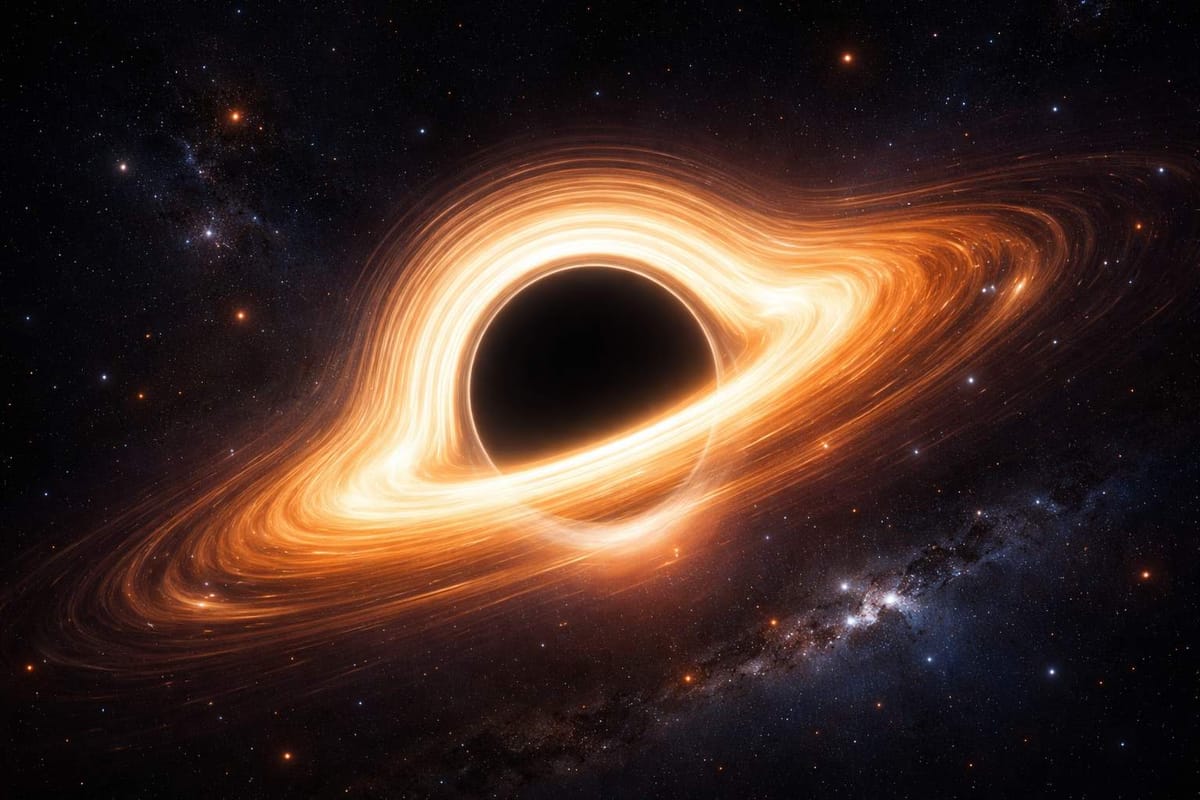
The Big Bang is usually depicted as the explosive birth of everything — the moment when space, time and matter first came into existence. But what if that’s not the full story? What if the event we call the Big Bang didn’t mark the absolute beginning of all existence, but instead was the aftermath of a collapse inside a black hole? A recent paper published in the journal Physical Review D [https://journals.aps.org/prd/accepted/fb072Q8eP8c1c24121775199b4d06e96f139e3b5d] by a team of theoretical physicists led by Prof. Enrique Gaztanaga suggests just that. According to their calculations, the Big Bang might have been a “bounce” that took place during the gravitational collapse of matter into a giant black hole — possibly one much larger than any we observe today.
Rethinking a Cosmic Beginning
In standard cosmology, the Big Bang theory describes how the universe expanded from an extremely hot, dense state about 13.8 billion years ago. That model has been phenomenally successful in explaining the large-scale structure of the cosmos. But it comes with unresolved puzzles, such as the need for inflation — a hypothesized ultra-rapid expansion driven by unknown new physics — and dark energy, the mysterious force behind the universe’s accelerating growth.
More fundamentally, the traditional Big Bang model begins with a singularity — a point where density and curvature become infinite and our physical laws break down. This mathematical divergence shows that the theory, while powerful, doesn’t truly explain how or why the universe began.
From Gravitational Collapse to Cosmic Expansion
The new idea turns this picture around. Instead of extrapolating backward to a singular start, the researchers ask what happens when matter collapses under gravity into an extremely dense object. Under general relativity, such a collapse forms a black hole. But when quantum effects — especially those that prevent particles from occupying the same state — are included, the collapse doesn’t crush everything into an infinitely dense point. Instead, it can stop and rebound.
In this scenario, the interior of the black hole becomes a new expanding region of space — a universe in its own right. To an external observer, this region is hidden behind the black hole’s event horizon, but from the inside it would appear as an expanding cosmos similar to the one we inhabit. The “Big Bang” would then be identified with the moment of rebound.
This approach — sometimes described as black hole cosmology — replaces the need for unknown inflation mechanisms with physics that might be grounded in well-studied principles, and it reframes cosmic origins as the result of processes we already observe in nature.
Implications and Questions
If the universe did originate inside a black hole, that opens profound questions about its “parent” environment: what kind of universe could host a black hole large enough to contain ours? And what are the observable consequences of such a history? Some proponents argue that this model could naturally produce features like cosmic acceleration or even aspects of the universe’s flat, smooth structure — without resorting to ad hoc fields or energies.
At the same time, testing these ideas remains a challenge. Distinguishing whether our universe began with a true singularity or with a bounce inside a black hole requires novel predictions that can be checked against observations. Future advances in cosmology — including deeper study of the cosmic microwave background and the large-scale structure of space — might help determine whether this alternative picture is more than an intriguing hypothesis.